Plenty of Fish holds a steady position across North America and the UK, and usage stretches further. Flashier rivals like Tinder or Hinge pull media attention, still POF keeps traffic and activity. We think that gap matters. Headlines do not always track real usage.
The question sits elsewhere. What actually happens inside the app, between profiles, messages, and silent threads that go nowhere. Anyone weighing a signup to the plenty fish app, or just checking relevance in 2026, needs the numbers, not the marketing layer. According to analysts, user structure and behavior tell more than surface claims. Gender balance, intent, reply patterns, even revenue signals. They shape the experience before the first message lands. Before digging into the pof statistics below, it helps to ask a simpler question first: how does pof work at its core.
10 Key POF Statistics
Here are 10 powerful statistics to help understand Plenty of Fish’s role in the modern dating landscape:
- Over 90 million registered users worldwide
- Approximately 2.5 million daily active users
- Men make up 60% of users; women 40%
- Most users are between 25 and 44 years old
- 30% of users are seeking long-term relationships
- About 70% of messages go unanswered
- The average user spends 11 minutes per session
- POF is used in over 20 countries
- More than 50,000 new users register daily
- POF has a 50/50 split in app vs. desktop use
Plenty of Fish User Demographics
Understanding who uses POF is critical for evaluating its effectiveness as a dating platform. From gender ratios to relationship intent, the following data sheds light on the people behind the profiles.
POF Male to Female Ratio
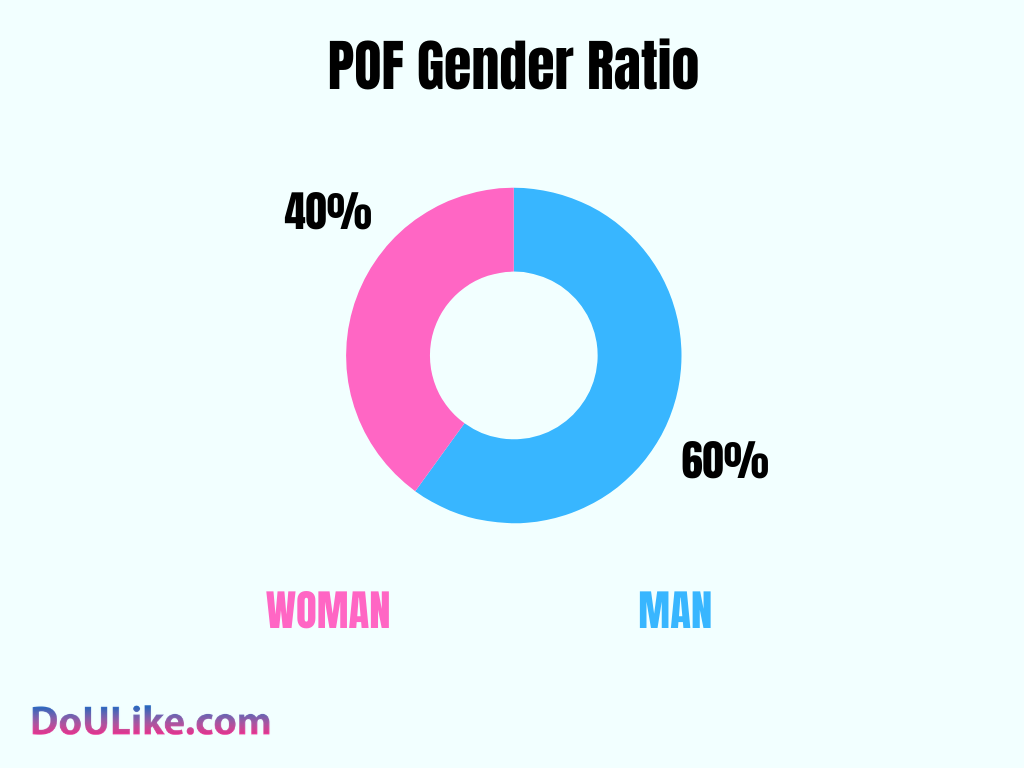
Men represent 60% of POF’s user base, while women on Plenty of Fish account for 40%. This common online dating gender imbalance impacts the experience: men often need to send more messages to receive replies, while women may face message overload.
Average Age of POF Users
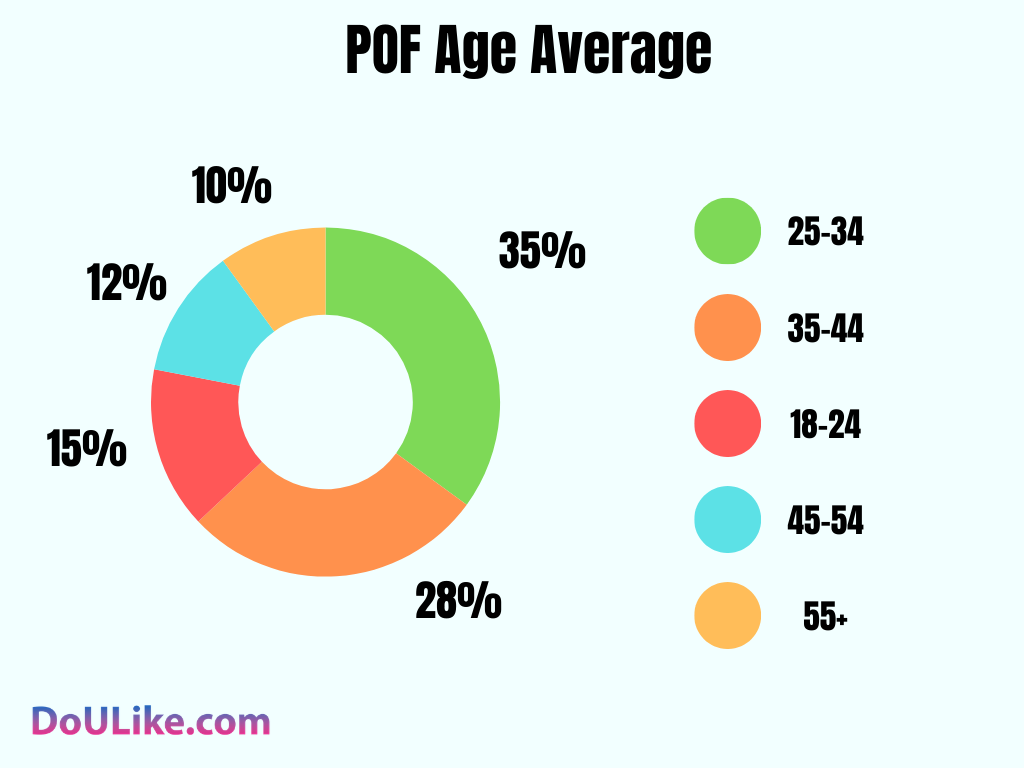

The Plenty of Fish age range caters to a broad audience. Here’s the breakdown:
- 25–34 years old: ~35% of the user base
- 35–44 years old: ~28%
- 18–24 years old: ~15%
- 45–54 years old: ~12%
- 55+ years old: ~10% (Business of Apps)
This spread shows that while younger users may flock to trendier apps like Hinge or Bumble, POF still captures a significant number of users in their late 20s to mid-40s. These age groups are often more relationship-focused, giving POF an edge in the serious dating segment. Knowing the pof age range ahead of time helps newcomers set realistic expectations.
Relationship Goals
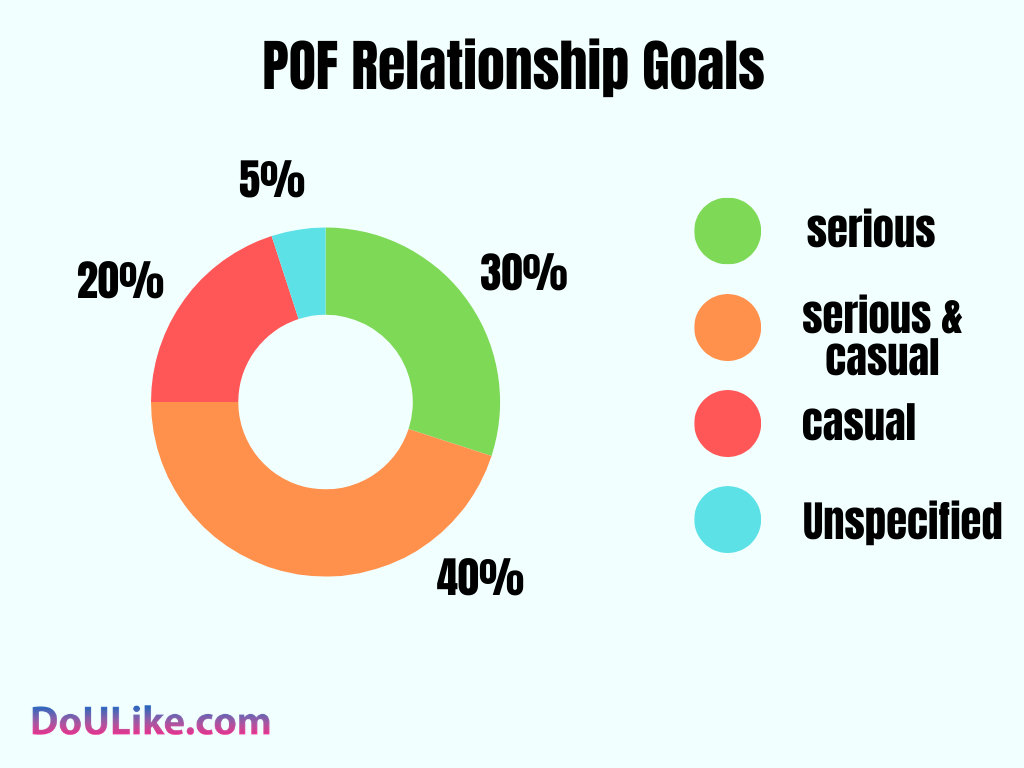
Plenty of Fish is known for being more relationship-oriented than some swipe-based apps. Here’s how relationship intent breaks down:
- Looking for a serious relationship: ~30%
- Open to both serious and casual: ~45%
- Primarily casual dating or hookups: ~20%
- Unspecified/just browsing: ~5% (Forbes)
The platform pushes depth. A long questionnaire, a chemistry test, that whole setup draws people chasing long-term partners. Still, free messaging keeps the door open for lighter intent. Low effort, quick chats, you know the drill. According to analysts, that mix explains the overlap in user goals.
Most Common Professions Among Users
POF has a wide variety of users, but certain career paths appear more frequently. Here are the top five most common professions listed by users:
- Healthcare workers (nurses, CNAs, therapists)
- Teachers and education professionals
- Retail and customer service workers
- Trades and technical jobs (electricians, plumbers)
- IT and tech-related roles (Wikipedia.org).
We think the healthcare skew tracks with age and stability preferences. Many users fall into the 25–44 bracket. They look for something steady. Detailed profiles help here, less noise, more signal. For people with demanding schedules, that matters. Quick swipes feel shallow, honestly.
Geographic Breakdown: Top Countries Where Plenty of Fish Is Used
POF began in Canada but has grown significantly worldwide. Here’s a breakdown of where the platform is most popular:
| Country | Estimated User Base | Notes |
| United States | ~40 million+ | Largest single market |
| Canada | ~10 million | POF’s origin country |
| United Kingdom | ~6 million | Strong European base |
| Australia | ~2 million | Popular among 25–40s |
| Germany | ~1 million | Growing steadily |
| Brazil | ~800,000 | Expanding Latin American presence |
| India | ~600,000 | Slower uptake, but growing |
| Other countries | ~5 million total | Including Ireland, New Zealand, and South Africa |
Users can adjust the Plenty of Fish location range to find nearby matches or browse people in new cities.
Comparison: Plenty of Fish (POF) vs. DoULike
POF and DoULike target users who feel drained by endless swiping, yet their mechanics diverge fast. Plenty of Fish leans on scale, open messaging, wide access. DoULike takes the niche dating route instead, narrowing the field, pushing compatibility, tighter profiles, more deliberate interaction.
The contrast shows up in user mix, match formation, and payment logic. Who joins, how they talk, what they pay for. Different bets.
| Category |   |  |
| Founded | 2003 | 2005 |
| Active Users | 90M+ registered users~2.5M daily active | 1+ million |
| Average Age | 25–44 years old | 30–45 years old |
| Male-to-Female Ratio | 60% men / 40% women | More balanced (boosted by free access for women) |
| Relationship Goals | 30% serious45% mixed20% casual | Primarily serious, value-based connections |
| Typical Professions | Healthcare, education, retail, trades, IT | Creative Fields, Medical, Business |
| Main Matching System | Open messaging + profile browsing | ValueMatch based on beliefs & life priorities |
| Mobile Apps | iOS & Android + desktop | iOS & Android |
| Top Countries | USA, Canada, UK, Australia, Germany | USA, Canada, UK, Australia, Europe |
| Pricing Model | Freemium + ads + subscriptions | Free for women; men pay only if you get a response |
| Cost | Premium plans from $19.99/month | Star Membership: from $19.95/month |
| Best For | Users who prefer long conversations and volume | People who want safe, value-driven dating with real profiles |
Plenty of Fish Match Statistics
Understanding how users interact on Plenty of Fish can reveal a lot about the platform’s success at fostering connections. From the number of messages sent to the actual “yes” rate between users, let’s take a closer look at what the data shows.
Average Number of Messages Exchanged Before a First Date
Users on Plenty of Fish usually exchange 10 to 15 messages before meeting. That number feels high, maybe even slow, though it matches how the platform works.
The app pushes longer conversations. Profiles carry more detail, so people read, react, then write back with intent. It is not swipe-heavy. Less rush, more talk. According to analysts, that design alone drives message volume upward before any offline step happens.
- Men start most conversations, roughly 8 out of 10 openers. No surprise there.
- Women tend to carry the thread further once it passes the third message, but only when replies feel real and considered, not copy-paste noise.
We think this exchange pattern acts as a filter. Users aiming for long-term outcomes lean into it, test compatibility early, avoid wasted dates. Casual users, though, often stall. Too many messages, not enough movement. The pace just feels off for them.
Subscription & Plenty of Fish Revenue Statistics
While Plenty of Fish offers a robust free version, it also monetizes through premium subscriptions, in-app purchases, and ad placements. Let’s break down its paying audience and financial growth.
Total Number of Paying Subscribers
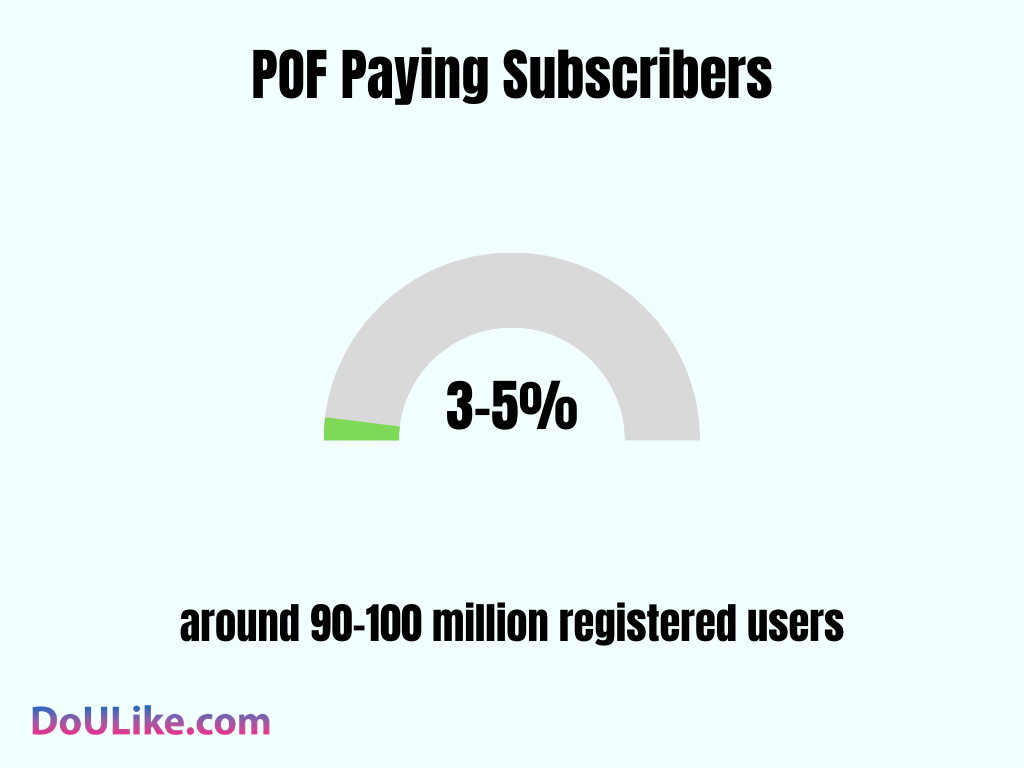
As of 2025, Plenty of Fish reports roughly 3 mn paying subscribers worldwide.
This figure equals about 3–5% of the total user base, estimated near 90–100 mn registered accounts. The share looks small. Still, according to our analysts, that conversion level sits in line with freemium dating platforms.
Users generally subscribe to gain access to premium features such as:
- Seeing who viewed their profile
- Sending messages without ads
- Read receipts
- Profile highlighting
Breakdown: Subscription Plans and Their Popularity
POF offers tiered subscription options. Here’s a breakdown of the most popular choices:
| Plan Type | Duration | Cost (Approx.) | % of Subscribers |
| Premium – 1 Month | Monthly | $19.99 | 25% |
| Premium – 3 Months | Quarterly | $38.97 | 40% |
| Premium – 6 Months | Biannual | $59.94 | 35% |
Wondering how much is Plenty of Fish per month? It starts at about $19.99, with bulk plans offering better value. So how much does POF cost depends on your plan duration and region.
Annual Revenue and Financial Growth Trends
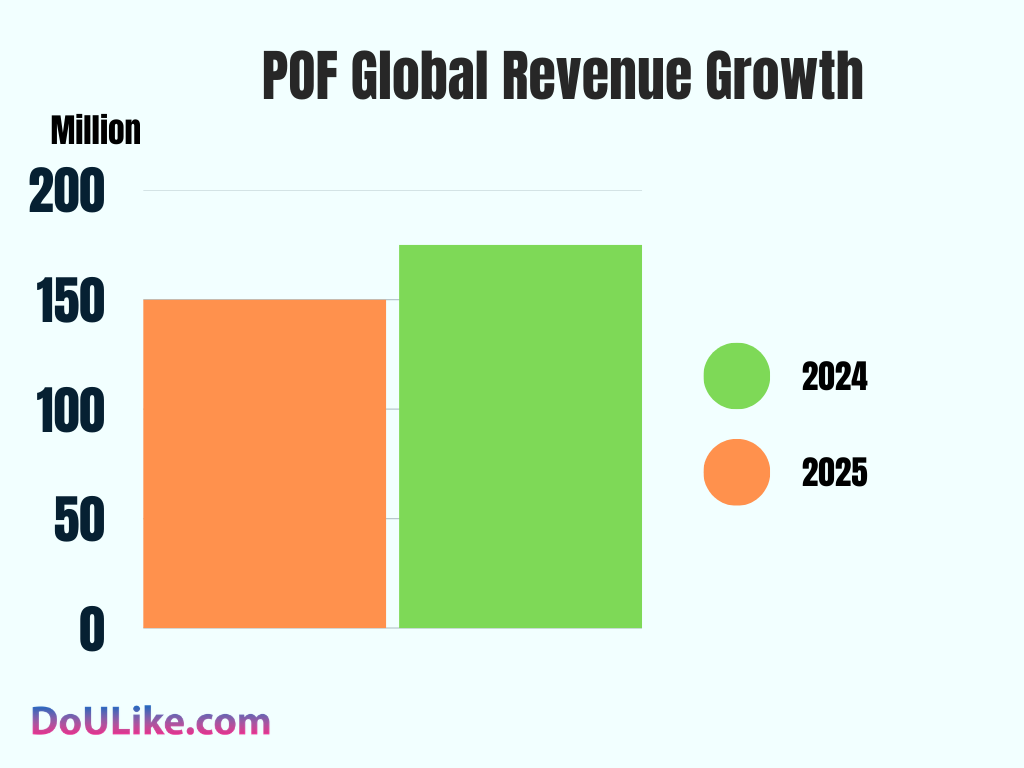
Plenty of Fish was acquired by Match Group in 2015, and since then, it has consistently contributed to the company’s revenue stream. While it isn’t the most high-growth property in their portfolio (compared to Tinder), it remains profitable.
- Estimated 2024 revenue: $150 million
- Projected 2025 revenue: $165–175 million
- Revenue growth YoY: ~10–12% (Klick Me).
Plenty of Fish revenue continues to grow thanks to subscriptions, ad placements, and video monetization.
Is Plenty of Fish Still a Popular App?
Do people still use Plenty of Fish? Without a doubt. It remains one of the most downloaded and active dating platforms.
Reasons POF is Still Popular:
- Large user base: Especially among users aged 25–44
- Free messaging: No paywall to start conversations
- Detailed profiles: Appeals to people looking for substance
- Desktop option: Still important to some demographics
POF is especially strong in North America, the UK, and Australia, and it is carving out space in countries like Brazil, India, and Germany. Its simplicity, functionality, and reputation for serious dating continue to give it an edge, especially among users tired of swipe culture. Plenty of Fish success stories, from long-term relationships to marriages, keep surfacing and reinforcing that reputation (Similarweb).
Conclusion
Plenty of Fish does not chase headlines like newer apps. It holds ground through steady usage and real user interaction, that’s the point. According to our analysts, the platform keeps a wide age spread, attracts serious relationship intent, and still reports marriages tied to matches. Not flashy. Still active.
People still ask basic questions. How POF works, what it costs, whether anyone even uses it anymore. Fair. The data answers most of that. Daily activity stays high, user volume runs in the mn, and revenue keeps growing year by year. Not explosive, but stable.
We think the appeal sits in its format. Less swiping, more direct messaging, more time spent actually talking. For users who want that shift, it fits. Broad geography helps too, coverage stretches across many regions without heavy drop-offs.
Maybe it looks dated to some. Honestly, that misses the point. It keeps delivering for a specific user type, those who move past quick matches and want actual conversation.
Our Editorial Team at DoULike understands the challenges of today’s dating scene. That’s why we offer guidance on everything from online profiles to in-person chemistry. With our tips, you’ll feel ready to take the next step in finding love.
